This post was originally published on this site.
When it comes to home defense, armed citizens must consider a range of topics. These include making emergency plans, hardening their habitations, applying passive security measures, implementing active security measures, being aware of local legal considerations, and more. But what about firearm selection? Does a bullpup carbine make a good home defense option? We take a look at the IWI Tavor X95 bullpup carbine and its place in a home defense plan.
Running a Bullpup, Like the IWI Tavor X95 Carbine for Home Defense
Firearms selection comes with its own nuances. Ammunition selection, optics, accessories, suppressors (if applicable) are some considerations that one has to ponder. My point is that home defense is no small subject. Any decent writer who is knowledgeable about this topic probably wouldn’t have a hard time filling up enough pages to write a book about it.
Advertisement — Continue Reading Below
To keep things simple, this article focuses on property and home defense with the semi-automatic carbines—specifically bullpup rifles.
And yes, in the fairness of this important topic, I’ll mention up-front that bullpups, or any type of semi-automatic rifle, may not be ideal for all property or home defense scenarios.
Advertisement — Continue Reading Below
Some of that will depend on the legality, some will depend on the specific circumstances of the space being defended, and some will also depend on the armed citizens themselves. Modern tactical rifles of any stripe aren’t necessarily the lightest shoulder-fired weapons. I don’t think any of us would want our grandmothers to necessarily rely on a 50.63 PARA FAL for home defense, per se.
There’s also the skill-at-arms issue. For example, for many years, my go-to firearm for home defense was my Beretta 1301 Tactical shotgun. I spent a considerable amount of time shooting and handling it alongside two other similar Beretta shotguns, the 1301 Comp and the A400 Target. All have the same manual of arms, and I became extremely comfortable with them.
For perspective, for every 100 12-gauge shells I shot, I barely fired one round of 5.56 in those days.
Advertisement — Continue Reading Below
When Rifles Make Sense for Home Defense
But there are times when a semi-automatic rifle or carbine can be the right choice for the home defender. Factors may include living in more spread-out rural areas where the risk of errant shots landing on neighbors’ homes is lessened. Likewise, a semi-automatic rifle could be a reasonable choice, depending on local law enforcement response times (something else that goes hand in hand with living in further spread-out rural areas).
Threat levels are another factor to consider, with doorbell camera footage of multiple home invaders becoming increasingly more common.
And, leaning on my shotgun example I shared above, it wouldn’t be unreasonable for someone who is more than comfortable with carbines to reach for one for home defense. Especially if their living situation accounts for the avoidance of ammunition overpenetration or stray rounds hitting their neighbors’ property.
Advertisement — Continue Reading Below
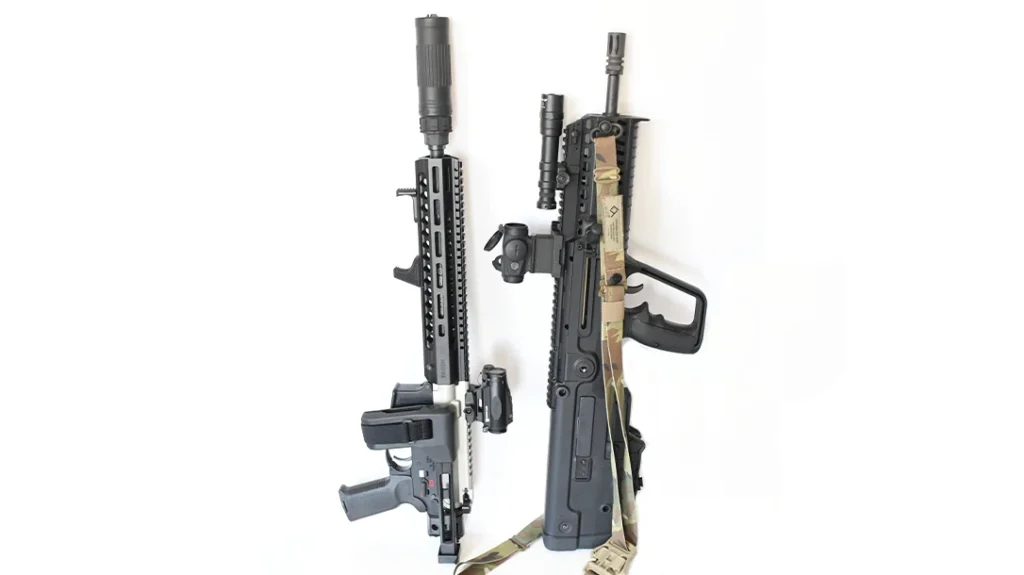
Zeroing In on Bullpups
Bullpup rifles, whose principal concept is the placement of their actions behind the trigger, are nothing new. The concept actually dates back to 19th-century Britain. In a modern context, the bullpup concept gained traction militarily not long after the end of the Second World War.
The single greatest attribute of the bullpup rifle concept is its “efficient use of space.” In other words, because the action sits behind the trigger where the stock normally is, the overall weapon is more compact. It takes up less space. And the best part? Bullpups can take advantage of longer barrels without having them get in the way. Longer barrels aid in both muzzle velocities and terminal ballistics.
Advertisement — Continue Reading Below
In the context of home defense with a semi-auto rifle, the bullpup’s compact attributes garner a look. Not only does their ‘abbreviated’ size make them easier to stow, but it also comes in handy if the home defender needs to maneuver around their house and property. The bullpup’s size makes it easy to sling up and carry without worrying about extra length or bulk.
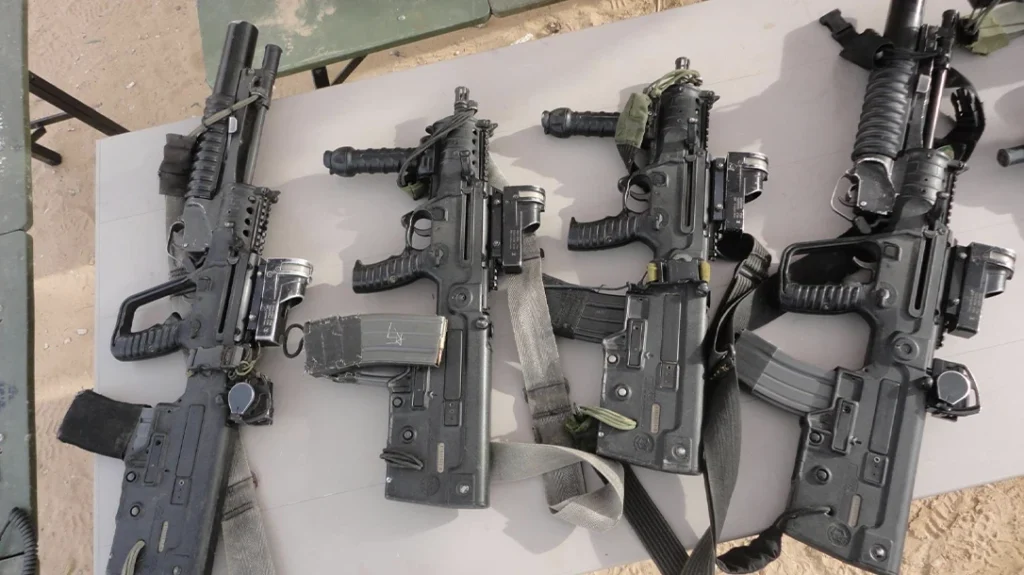
In the United States, gun laws that arbitrarily limit rifle barrel lengths exist. Generally speaking, possessing a firearm with a barrel less than 16 inches involves the same type of extra red tape and fees (at the time of this writing) as possessing a silencer does.
Advertisement — Continue Reading Below
The typical bullpup carbine has a barrel measuring between 16 and 20 inches in length. Their designs move the action and entire barrel assembly further back. So, those longer barrels “feel” shorter overall, not unlike legally-regulated SBRs (short-barreled rifles). It’s not a loophole or workaround or a cheat. The legal barrel just sits further to the rear.
Bullpup In Focus: The IWI Tavor X95
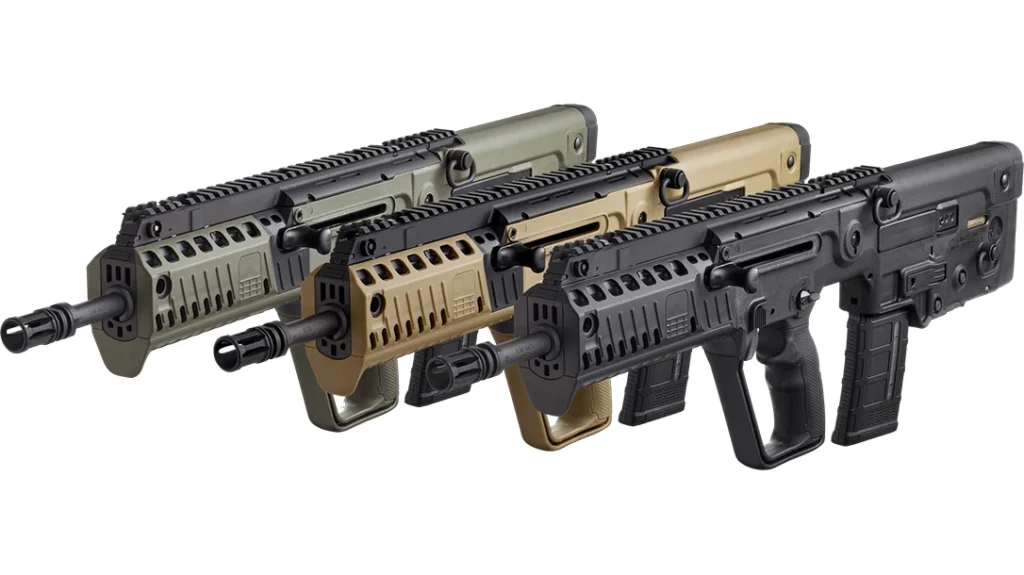
The IWI Tavor X95 is the current iteration of the original Israeli Tavor TAR-21. This bullpup family isn’t all that old because the original Tavor TAR-21 only dates back to the year 2001.
Amongst bullpup rifles, Tavors are somewhat unique in that they specifically employ a long-stroke gas piston action. Conceptually, the Tavor action isn’t unlike what is found in Israeli Galils (which borrowed the idea from the Finnish Valmet/RK-62, which in turn was adapted from Kalashnikov’s legendary action).
The Tavor series was designed to be a handy, compact, and reliable service rifle for IDF troops operating in/around urban terrain. This includes clearing rooms, which can overlap with home defense duties.
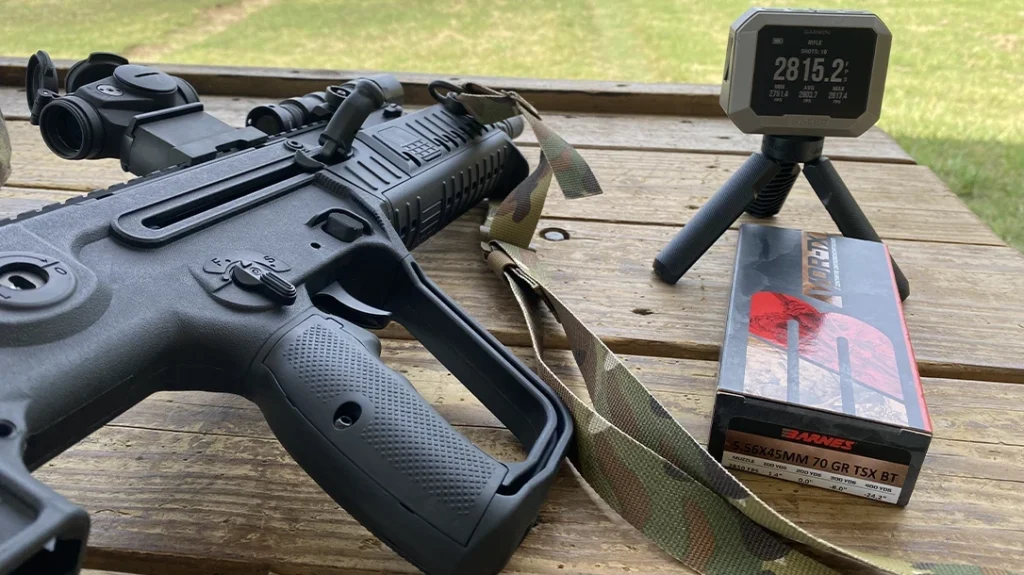
The gas ports found on these respective models are all designed to deliver a stout amount of gas in order to actuate the piston system and ensure that the action functions, no matter what. For extremely sandy and dusty Middle-Eastern environments, setting carbines up for that level of reliability is sound policy.
Besides the fact that bullpups don’t really have adjustable stocks since the action occupies that space, another drawback is that they’re not as ambidextrous as standard carbines, given the location of their ejection ports. Fortunately, the Tavor’s architecture is modern. So, its design is more adaptable toward left-handed shooters than other bullpup carbines.
Whether configured for left or right-handed use, the X95 counts on a very user-friendly safety selector, accessible charging handle, and an ambidextrous magazine release situated in the perfect spot.
The X95’s center of mass is biased towards the rear. This makes it easier to swing its muzzle between targets more easily. Likewise, keeping the weight closer to one’s body reduces fatigue when shooting offhand or in prolonged “ready” positions.
Setting Up the IWI Tavor X95 For Home Defense
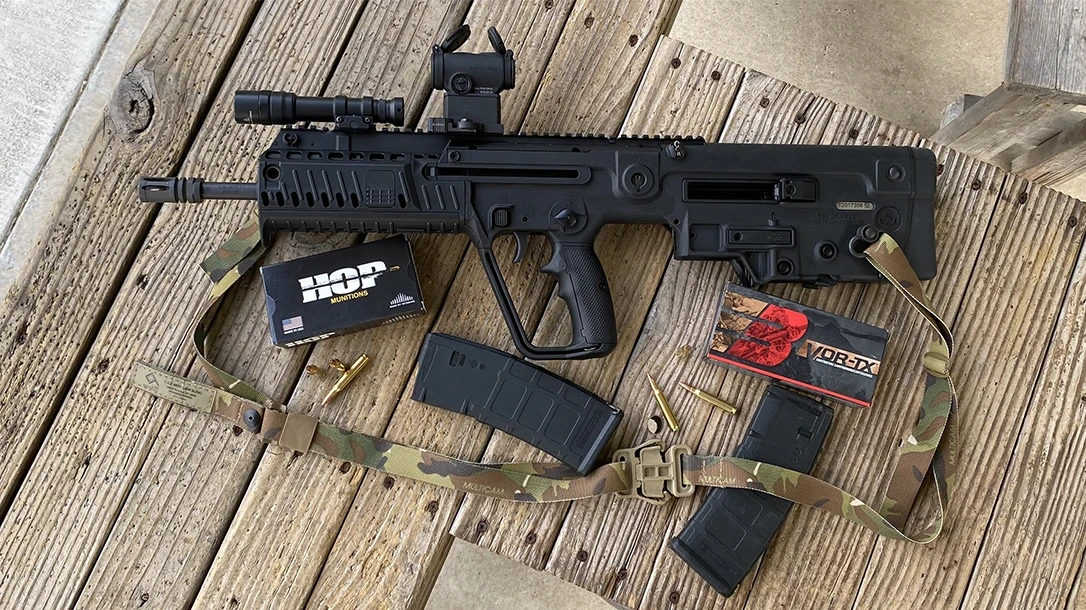
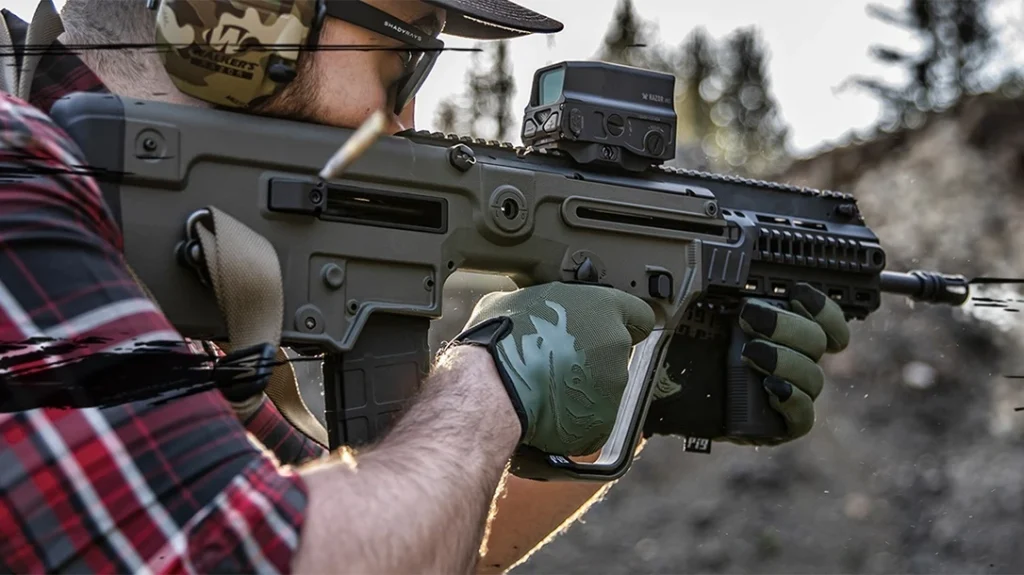
My Tavor X95, a left-handed factory-configured version, is currently set up for home defense in a straightforward and practical manner. It meets the most basic requirements needed in any defensive carbine: an optic, sling, and tactical light.

Optic: Aimpoint Duty RDS
The Aimpoint Duty RDS is Aimpoint’s entry-level priced non-magnified compact reflex optic. Like its more established [and more expensive] older brother, the Aimpoint T-2, the Duty RDS shares the Aimpoint Micro footprint.
It runs off standard CR2032 batteries. It neither weighs much nor takes up much space, which is in line with the philosophy of using a [compact] bullpup carbine for home defense. Furthermore, its 2 MOA red dot is plenty bright and suitable for the task at hand.
Due to the layout of the Tavor and the fact that it doesn’t technically have a stock in the traditional sense, the Aimpoint Duty RDS sits on an extended LaRue mount.
Tactical Light: Surefire M600 DF
I bought this white light many years ago. While it doesn’t have cables or fancy switches, it throws a bright beam and easily illuminates any room. Prior to the Tavor X95, it lived on my Beretta 1301.
Its basic thumb-screw Picatinny mount allows me to easily mount on the X95’s Picatinny top rail ahead of the Aimpoint. The only downside to mounting a light in this position is that it blocks the X95’s auxiliary flip-up iron sight. On the bright side (pun intended), the light sits in line with the optic and does not jut out or become a snag hazard.
Sling: Law Tactical ARS Mod Sling
Law Tactical’s ARS Mod sling is a traditional two-point tactical carbine sling that features a prominent buckle. It allows the end-user to “cut” the sling off if they’re in a hurry. Aside from that, the ARS Mod sling itself is low profile in terms of both its “strap” and keepers, while also being easy to adjust on the fly smoothly.
Feeding the X95: 5.56 Defensive Ammo for Bullpups
Bullpup or not, a proper home defense carbine (of any caliber) still requires suitable defensive ammunition. Projectiles in defensive ammunition typically expand upon impact, which accomplishes two goals.
First, expanding projectiles better transfer kinetic energy into the target, which helps stop threats more quickly (the primary goal of a defensive firearm). Second, by virtue of expansion, projectiles are less likely to overpenetrate. Law enforcement carries defensive rifle and pistol rounds in their duty firearms for the same reason.
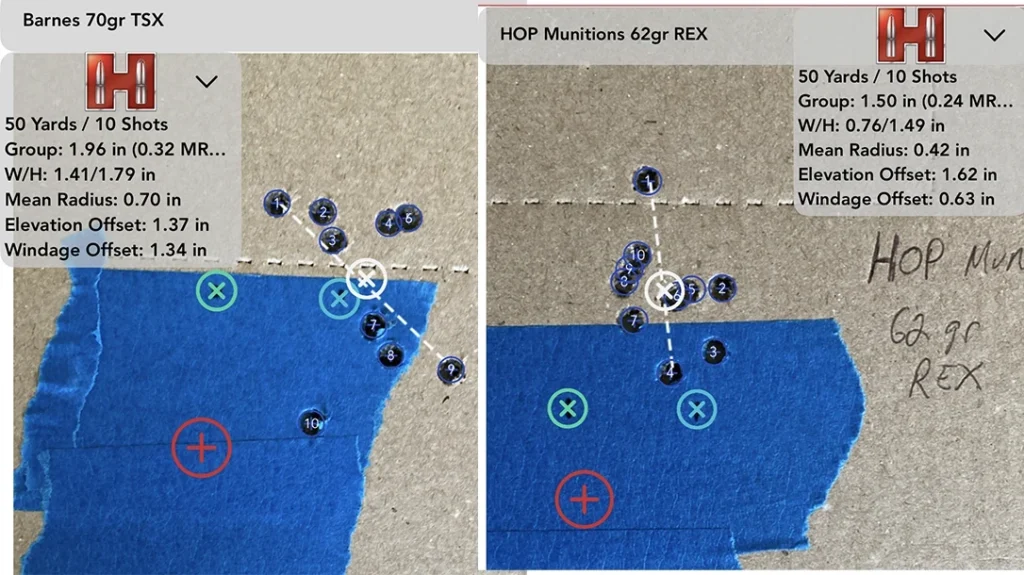
Nearly every major ammunition company offers suitable 5.56mm defensive ammunition. I’m showcasing the Barnes Vor-TX 70-grain TSX and the HOP Munitions 62-grain REX in this article. Coincidentally, both of these 5.56mm NATO cartridges are loaded with solid-copper expanding projectiles and are suitable for home defense in any 5.56mm firearm.
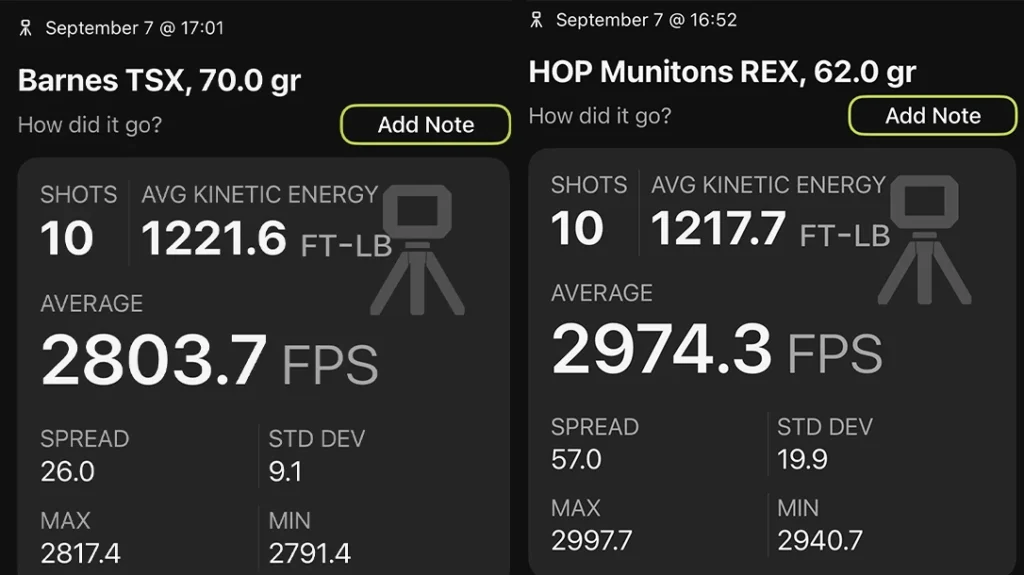
Even though this isn’t a “review,” I took the time to shoot some 10-round groups and chronograph the muzzle velocities of both the Barnes and the HOP Munitions loads at 50 yards. Civilian defensive encounters often occur at even shorter distances. So, 50 yards is a reasonable threshold to gauge accuracy potential.
Bullpups, including the X95, get a bad rap for having “terrible” triggers. It’s true that bullpups do require additional linkage given their layouts. However, I was still able to print two decent 10-round exemplary groups with a non-magnified reflex sight.
In all, the Tavor’s accuracy with these high-end defensive loads is more than acceptable for home defense and similar scenarios.
Closing Thoughts
It’s fair to mention that some of the points I make above also apply to other bullpup rifles when it comes to home defense.
In my case, the IWI X95 Tavor is the bullpup firearm with which I have the most hands-on experience. Not to mention trigger time. One of the reasons I like my [left-handed] Tavor X95 is that this bullpup is basically a mash-up of an AR-15 and a Kalashnikov.
By that, I mean that the safety-selector is placed right next to the grip, so I don’t have to “think” about using it, since it works just like an AR-15’s safety-selector. The charging handle is on the right, no different than any Kalashnikov that I’ve ever handled—another no-brainer for me.
Ultimately, whether it’s a Tavor, a Springfield Armory Hellion, a Desert Tech, or any other suitable bullpup, these types of carbines can offer some advantages for home defense in terms of compactness, handling, and maneuvering.
And that’s where the bullpup really shines. Its form factor makes it so much easier to walk around with it at the ready or low-ready. All the weight is “behind you” as opposed to “in front of you,” so to speak. This means that the shooter isn’t fighting against the weight of the barrel in front of them.
With all the weight to the rear, it’s so much easier to swing the muzzle up, away, and slice around corners. Depending on one’s specific home defense situation, this could come in rather handy.
Performance
| Barnes Vor-TX 70-grain TSX Solid Copper | |
| Muzzle Velocity Data (FPS) | 2803.7 |
| Extreme Spread, Inches | 1.96 |
| HOP Munitions 62-grain REX Solid Copper | |
| Muzzle Velocity Data (FPS) | 2974.3 |
| Extreme Spread, Inches | 1.49 |
10-round groups @ 50 yards
WHY OUR ARTICLES/REVIEWS DO NOT HAVE AFFILIATE LINKS
Affiliate links create a financial incentive for writers to promote certain products, which can lead to biased recommendations. This blurs the line between genuine advice and marketing, reducing trust in the content.
The post Beware of Bullpup: Home Defense with the IWI Tavor X95 Bullpup Carbine appeared first on Athlon Outdoors Exclusive Firearm Updates, Reviews & News.